
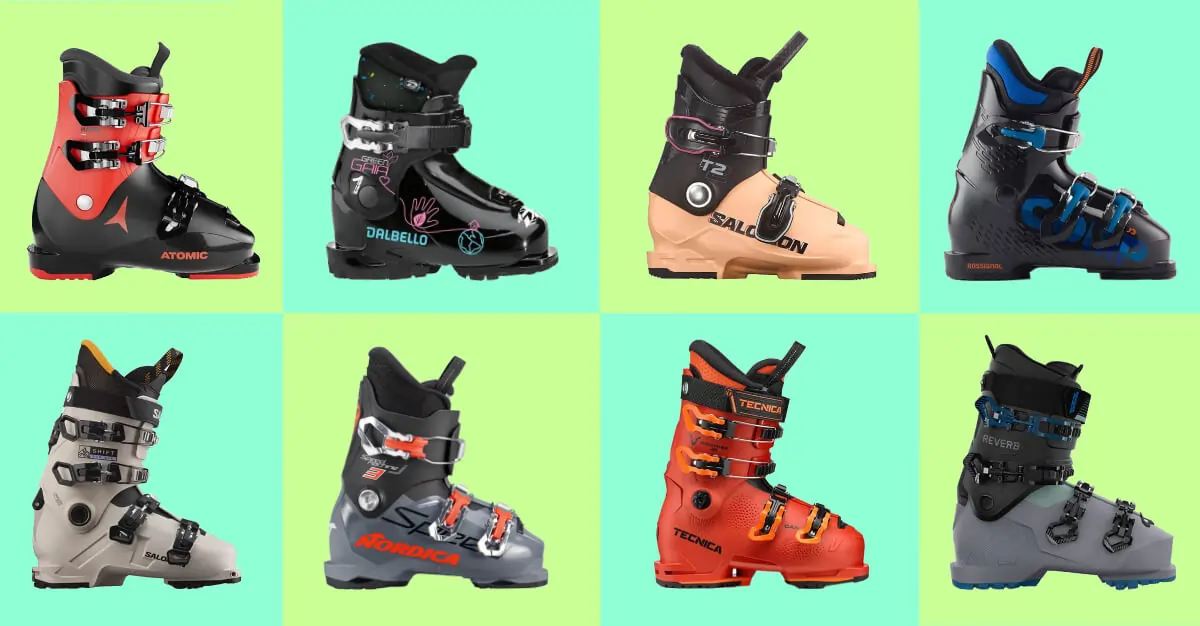
After 50+ days on snow, two clear standouts emerged
If skis are the engines of modern alpine skiing, boots are the steering wheel, brakes and suspension rolled into one. They are the single most important piece of equipment a skier owns—and yet they remain the most misunderstood, most uncomfortable and most commonly mis-purchased item in the ski world.
“It doesn’t matter how good your skis are,” says Austin Nelson, a boot fitter with 15 years of experience and store manager at Surefoot in Aspen, Colorado. “If your boots don’t fit properly, you’re going to ski worse. Period.”
The old industry adage still holds true: Date your skis, marry your boots.
With that in mind, I spent several months testing 12 pairs of ski boots across a wide range of terrain, conditions and skier needs at Aspen Snowmass Ski Resort. Powder days, refrozen groomers, spring slush, steep bumps and long chairlift days all factored into the evaluation. A second tester—a wide-footed, experienced male skier—tested men’s versions using the same rubric. Also read this
After more than 50 combined days on snow, two boots clearly rose above the rest: one for pure downhill performance and one for skiers who want a single boot capable of both resort skiing and touring.
These are the best ski boots of 2026.
Why Ski Boots Matter More Than Ever
Ski boots serve as the literal connection between your body and your skis. Every movement—edging, pressure, balance, rotation—is transmitted through the boot. A well-fitting boot improves control, efficiency and confidence. A poorly fitting one does the opposite, often leading to cold feet, pain, fatigue and stalled progression.
Modern ski boots are also more complex than ever. Today’s buyers face:
- Multiple last widths and volume options
- A wide range of flex ratings
- Heat-moldable liners and shells
- GripWalk soles
- Walk modes
- And now, increasingly, BOA fit systems
Choice is good—but only if you know what to look for.
That’s why real-world testing matters.
How We Tested
Each boot was evaluated across five categories:
Comfort
- Width and volume compatibility
- Heel hold and cuff pressure
- Out-of-the-box feel vs. post-boot-fitting feel
Performance
- Flex consistency and predictability
- Responsiveness across terrain
- Stability in high-speed turns, bumps and steeps
Durability
- Shell integrity
- Buckles, BOA systems and walk-mode reliability
Features
- Effectiveness of BOA vs. buckles
- Walk-mode usability (for hybrid boots)
- Power strap design
- GripWalk sole performance
Temperature Regulation
- Ease of entry on cold days
- Warmth retention over long sessions
To add objective data, I used Carv, a digital ski coach that collects in-boot metrics such as balance, pressure distribution and stability. Each boot was skied on the same runs, with the same skis, by the same skier—making the boots the only variable.
All boots were tested out of the box for at least one week, then professionally fitted at Surefoot to assess how performance changed with proper customization.
Best Downhill Ski Boots of 2026
Tecnica Mach1 MV 120
Ski boots are not known for comfort. That’s why it’s so striking when a pair feels good immediately.
The Tecnica Mach1 MV 120 did exactly that—and then backed it up with elite downhill performance across every condition we threw at it.
Fit That Actually Works
One of the Mach1’s biggest strengths is its three-volume platform:
- LV (98 mm) for narrow feet
- MV (100 mm) for average feet
- HV (103 mm) for wide feet
This alone makes the Mach1 more accessible than many high-performance boots. I tested the HV version but also skied the MV model extensively and found both impressively comfortable.
Tecnica’s anatomically shaped shell deserves much of the credit. While no plastic ski boot is ever truly “plush,” the Mach1 delivered one of the best out-of-the-box fits in the test. Pressure points were minimal, heel hold was excellent, and there was none of the painful forefoot squeeze that plagues many performance boots.
After a professional fitting—custom liners, footbeds and shell work—the boot felt truly dialed.
Power Without Punishment
The Mach1 MV 120 strikes an ideal balance between stiffness and forgiveness. Its carbon spine, which connects the cuff to the shell, regulates flex so power delivery feels smooth and predictable rather than abrupt.
In real terms, that means:
- Strong edge engagement on groomers
- Stability in chopped powder
- Confidence in steep, technical terrain
Carv data supported what I felt on snow, showing a 42% increase in balance during turns compared to my baseline boots.
Only one boot—the Lange Shadow 130 LV—felt more precise, but its narrower fit and less versatile feel pushed it behind the Mach1 overall.
Flex and Options
The Mach1 lineup offers excellent range:
- Men’s: 110 and 120 flex
- Women’s: 95, 105 and 115 flex
Tecnica has also entered the BOA arena with the Mach BOA HV, available in select flexes. While the BOA version doesn’t yet offer the same breadth of options, it’s a compelling choice for skiers who prefer the even pressure distribution of a dial system.
Verdict
The Tecnica Mach1 MV 120 earns our top downhill spot because it combines:
- Elite performance
- Excellent fit options
- Real-world comfort
- And outstanding customization potential
For intermediate to advanced resort skiers, it’s one of the safest—and smartest—choices you can make.
Best Hybrid Ski Boots of 2026
Salomon Shift Alpha BOA
For years, the “single-boot quiver” has felt like a myth.
Hybrid boots typically force a compromise: light and walkable but weak on the downhill, or powerful but miserable on the uphill. The Salomon Shift Alpha BOA comes closer than almost any boot yet to breaking that tradeoff.
Built for Both Directions
Hybrid boots must do two opposing things well:
- Ski downhill with authority
- Walk and tour efficiently
The Shift Alpha BOA manages both better than most.
Its walk mode offers a generous range of motion, making uphill travel noticeably more comfortable than traditional alpine boots. On the descent, however, it feels far closer to a true resort boot than expected.
BOA Done Right
The BOA system here isn’t a gimmick—it’s one of the best executions I’ve tested.
The dial evenly wraps the lower shell around the foot, eliminating hot spots and reducing the micro-adjustments often needed with buckles. Transitioning between uphill and downhill modes is intuitive, quick and reliable.
Notably, the walk-mode lever never once shifted unintentionally during testing—a common failure point in hybrid boots.
Real Downhill Authority
The Shift Alpha BOA 130 (men’s) and 115 (women’s) both deliver impressive stiffness and responsiveness. While they don’t quite match the Mach1 for pure downhill power, the difference is smaller than expected—and easily acceptable for skiers who split time between resort and touring.
Verdict
For skiers who want one boot to:
- Tour
- Ski lifts
- Handle variable terrain
- And still charge confidently
The Salomon Shift Alpha BOA is the best hybrid option we tested in 2026.
What to Know Before Buying Ski Boots
Ski boots are not like shoes. Most people are wearing the wrong size—and many are in the wrong volume entirely.
“A well-fitting boot allows you to progress faster and ski with less effort,” Nelson says. “Especially for beginners.”
Key takeaways:
- Fit matters more than brand
- Width and volume are as important as length
- Boot fitting is not optional if you want performance
- Comfort improves dramatically after customization
Always ski boots for several days before final judgment—and budget time and money for professional fitting.
The Bottom Line
After extensive, real-world testing, two boots stood clearly above the rest:
- Best Downhill Ski Boots: Tecnica Mach1 MV 120
- Best Hybrid Ski Boots: Salomon Shift Alpha BOA
Neither is cheap. But ski boots are an investment—not just in performance, but in enjoyment. When your boots fit well, skiing feels easier, smoother and more fun.
And that, ultimately, is what keeps us coming back to the mountains.