
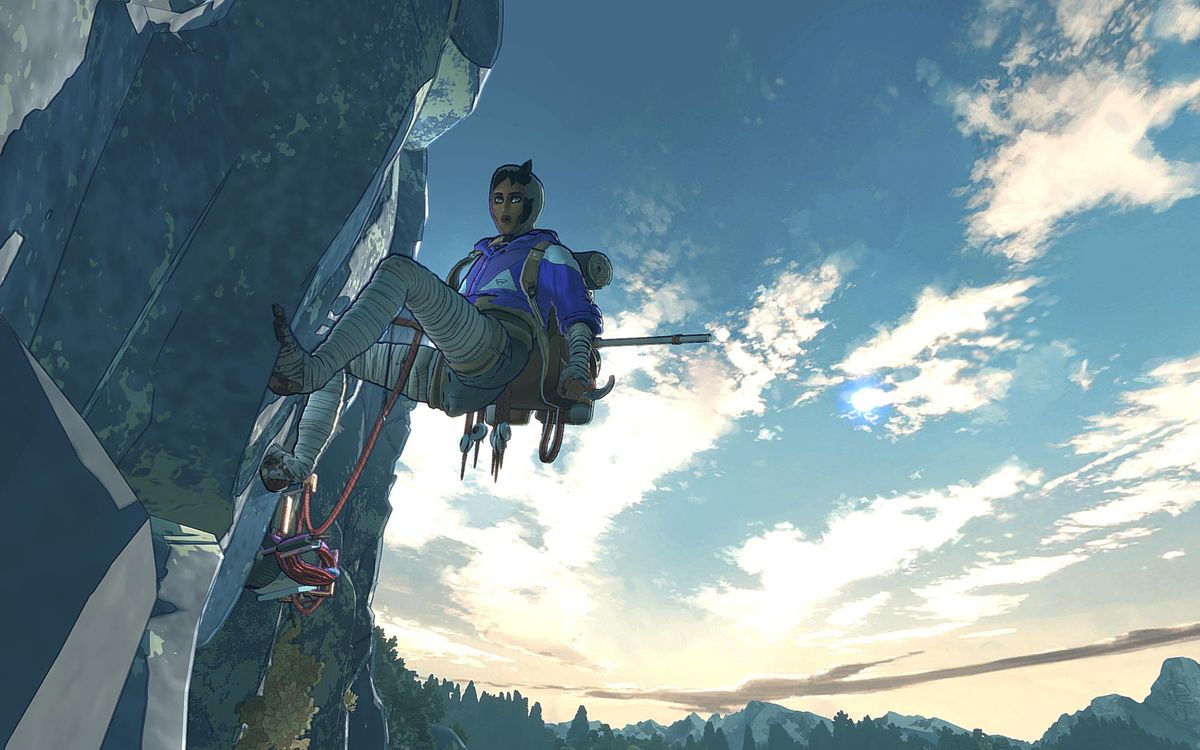
Several hours into my ascent of Mt. Kami, I encountered what felt like an impasse. I had descended into a crystalline cave formation carved deep into the mountain’s body, only to find that its walls were far denser than anything I’d faced before. No piton would bite into the surface. No safety line could be placed. Progress meant committing to a free solo climb—no margin for error, no mechanical safety net.
At least, that’s what I believed.
So I tried anyway. I forced Cairn’s protagonist, Aava, up those jagged walls, testing every razor-edged handhold and shallow crack for purchase. I failed again and again. Aava slipped. She screamed. Bandages tore from her fingers. Blood smeared the stone beneath her feet. Her anger felt directed not just at the impossible wall, but at me for insisting she climb it—and perhaps at herself for choosing Mt. Kami at all.
Eventually, through stubbornness more than skill, we cleared the cave. We emerged victorious, battered, and exhausted—only to discover an alternate route mere feet away. A gentler slope. A path that required none of the punishment I had just inflicted. Read this also
And the worst part? I had known. Deep down, I had known there must be another way.
Cairn didn’t trick me into that suffering. It offered me the choice outright. And like the kind of masochistic player Cairn so clearly understands, I took the hardest possible path simply because it was there.
That moment crystallizes what Cairn is: not just a climbing game, but a game about choice, self-imposed hardship, and the stubborn human desire to prove something—even when no one is asking us to.
The Weight of Every Decision
Developed by The Game Bakers (Furi, Haven), Cairn is a climbing and survival game that strips its premise down to essentials and then dares you to master them. Every action matters. Every mistake compounds.
Where will Aava place her hand? Which foot will she move next? Will you burn stamina to gain height now, or conserve energy for the brutal stretch ahead? When you reach an abandoned campsite, do you scavenge climbing gear—or ingredients to cook a meal that might keep you alive hours later?
Cairn is composed of these constant micro-decisions, and the brilliance lies in how naturally they flow. The game rarely pauses to announce its importance. It trusts the player to understand—often too late—that every choice carries weight.
Mechanically, Cairn is surprisingly restrained. It doesn’t bury the player under systems or tutorials. Instead, it drills relentlessly into a small set of ideas until they become second nature. That focus gives the game its teeth. I was constantly eager to see what challenge Mt. Kami would throw at me next, not because I wanted novelty, but because I wanted to test whether I had actually learned anything.
Climbing Without Illusion
Like Jusant before it, Cairn is fundamentally about climbing—but the comparison ends there. Where Jusant is meditative and forgiving, Cairn is punishing and physical. It places Aava’s survival squarely in the player’s hands, and then reminds you—frequently—that those hands are human, flawed, and prone to error.
Climbing in Cairn is not cinematic. It is not graceful. It is often ugly, awkward, and brutal.
You control Aava’s limbs individually, placing each hand and foot with deliberate intent. The game may suggest which limb to move next, but where it goes is entirely up to you. Aava contorts herself into uncomfortable angles to maintain balance, and it’s up to the player to recognize when that balance becomes unsustainable.
There are no glowing handholds. No generous auto-corrections. In fact, Cairn largely eschews UI during climbs altogether. Instead, you must read Aava’s body language, listen to her breathing, and recognize the difference between a solid grip and a tenuous one through subtle audio and animation cues.
When you get it right, the result is deeply satisfying. When you get it wrong, Aava’s knees buckle, her arms tremble, and gravity does the rest.
You will fall. Often.
Learning Through Failure
Failure is not just expected in Cairn—it is essential. I grew intimately familiar with Aava’s frustrated screams as she plummeted from my poorly chosen routes. I learned the visual language of exhaustion as the screen blurred from hunger, cold, or thirst. I watched her black out on the rope more times than I care to admit.
Over the course of my roughly 12-hour climb, these failures humbled me. They forced me to confront how reckless my decisions were—how often I prioritized speed over form, progress over preservation. Early on, I burned stamina carelessly, only to be punished during longer, more demanding ascents that required patience and restraint.
Unlearning those bad habits became part of the game’s quiet mastery. Through repetition—through falling—I learned to spot narrow fissures that could bridge otherwise impossible gaps. I learned when to rely on pitons and when to trust my grip. I learned how much effort was enough.
And when I finally pulled off a risky climb using nothing but precise placement and discipline, the sense of accomplishment was profound.
Survival as a Simple Truth
Beyond climbing, Cairn incorporates survival mechanics that are refreshingly grounded. Aava must eat, drink, and stay warm. If she doesn’t, she dies. The system is not complex, but it is unforgiving.
At bivouacs—the game’s save points—Aava can pitch a tent, repair pitons, recycle materials through her small robotic assistant, cook meals, and sleep to recover. Resources are limited, and her backpack has finite space, forcing hard decisions about what to carry forward.
Food can provide more than just sustenance. Better recipes yield lasting buffs, improving stamina or freezing survival meters temporarily. One particular effect, “grit,” became invaluable during extended climbs, allowing me to focus entirely on execution without worrying about hunger or thirst creeping in.
Crucially, Cairn avoids turning survival into busywork. Cooking is useful, not tedious. The system respects the player’s time while maintaining stakes.
A Mountain of Ghosts
As beautiful as Mt. Kami is, it is also littered with reminders of failure. Aava scavenges supplies from streams, bear-proof boxes, and abandoned camps—but also from the bodies of climbers who didn’t make it.
These moments are quiet, unsettling, and deeply effective. Each corpse is a warning. Each forgotten backpack a testament to ambition undone. Cairn never sensationalizes these deaths, but it never lets you forget them either. The mountain is indifferent and hungry.
Aava, the Person Behind the Climb
Though Cairn can feel solitary, it is not without human connection. Occasional phone calls punctuate the ascent: a concerned partner, a frustrated manager, fellow climbers crossing paths briefly before disappearing back into the mountain’s vastness.
Through these interactions, a picture of Aava emerges. She is accomplished, respected, and deeply dissatisfied. A renowned athlete, she is also someone running from expectations, from relationships, from something unresolved.
Why climb Mt. Kami? Why risk death to escape life? Why push everyone away?
Cairn doesn’t rush to answer these questions. It respects Aava enough to let her remain complicated. Her journey is not framed as noble or reckless—it simply is. And that restraint lends the story its power.
As someone familiar with isolation and avoidance, I found myself empathizing deeply with Aava. Her climb became less about reaching the summit and more about enduring the journey—about seeing if something on the other side might make the pain worthwhile.
A Shared Ascent
At some point, the wall between Cairn disappeared. I wasn’t just controlling Aava; I was climbing with her. I felt every moment of terror as storms rolled in, every quiet pause beside a waterfall, every adrenaline-fueled breakthrough.
Cairn may look like a solo journey, but it feels like a partnership. Without me, Aava wouldn’t have made it. Without her, I wouldn’t have experienced the mountain’s brutal beauty or confronted my own willingness to choose suffering when an easier path exists.
Together, we reached the summit—not for answers, but for closure. Not to fix everything, but to prove that walls are just walls. Whether you go over them, around them, or break yourself trying, the act of facing them matters.
Final Verdict
Cairn is not an easy game. It is not always fun in the conventional sense. It is demanding, punishing, and unapologetically physical. But it is also honest, thoughtful, and deeply human.
By trusting the player, respecting its protagonist, and embracing failure as a teacher rather than a punishment, Cairn delivers one of the most affecting climbing and survival experiences in recent memory.
It asks you a simple question: How far are you willing to go, and why?
And then it hands you the mountain.
Score: 9 / 10
A grueling, intimate climb that rewards persistence, humility, and empathy in equal measure.