
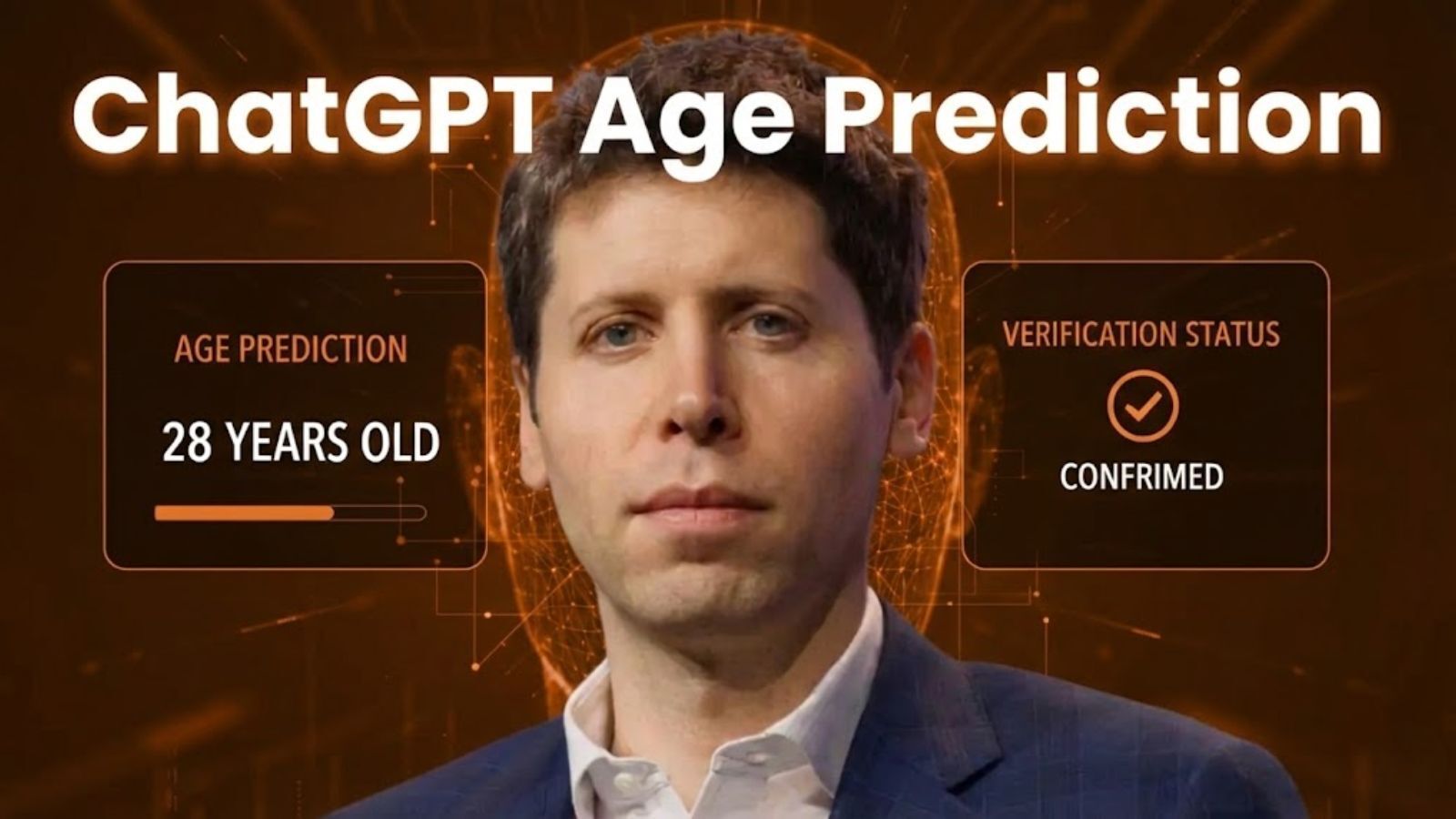
Artificial intelligence is no longer a niche technology reserved for researchers, engineers, or adult professionals. Over the last few years, AI platforms—particularly conversational tools like OpenAI’s ChatGPT—have become part of everyday life for people across age groups. Students use AI to study, teenagers turn to it for explanations and creativity, and adults rely on it for work, planning, and decision-making.
As AI adoption accelerates, one issue has moved to the center of global discussion: age-appropriate interaction. How can powerful AI systems remain accessible to everyone while ensuring that minors are protected from harmful or unsuitable content?
To address this challenge, OpenAI has introduced a new age prediction system for ChatGPT—a behind-the-scenes mechanism designed to estimate whether a user may be under the age of 18 and adjust the experience accordingly. The system does not ask users directly how old they are. Instead, it analyzes patterns of interaction to determine whether additional safety measures should apply.
The update marks a significant moment in AI governance, raising important questions about safety, privacy, transparency, and the future of responsible artificial intelligence.
Why Age Prediction Has Become a Priority for AI Platforms
AI systems today are vastly more capable than earlier digital tools. ChatGPT can explain complex topics, generate creative content, simulate conversations, and respond to sensitive questions. While this power makes AI extremely useful, it also increases the risk of exposing younger users to content they may not be ready to process.
Teenagers and minors increasingly use AI for:
- Homework assistance
- Exam preparation
- Writing support
- Mental health questions
- Curiosity-driven exploration
This widespread use has forced AI developers to confront an uncomfortable reality: self-declared age is unreliable. When platforms rely solely on users entering a date of birth, there is little preventing minors from misrepresenting their age—intentionally or unintentionally.
OpenAI’s new system reflects a broader industry shift away from trust-based age verification and toward behavioral estimation models that operate quietly in the background.
What Is ChatGPT’s Age Prediction Feature?
ChatGPT’s age prediction feature is a machine learning-based safety system designed to estimate whether an account is likely being used by someone under 18. If the system believes a user may be a minor, ChatGPT automatically applies a teen safety experience.
This experience includes:
- Stricter content moderation
- Reduced exposure to explicit or graphic material
- Safeguards around self-harm, eating disorders, and dangerous behaviors
- More cautious language and explanations
Importantly, the system does not “know” a user’s exact age. Instead, it assigns a probability based on multiple signals and then decides whether protective measures should apply.
OpenAI has emphasized that the system exists to protect younger users, not to police adults.
How Does ChatGPT Predict Your Age?
Unlike traditional systems that rely on declared birthdates, ChatGPT’s age estimation is based on behavioral and contextual analysis. According to OpenAI, the model considers a combination of signals rather than a single factor.
These signals may include:
1. Usage Patterns
The frequency and duration of sessions can offer clues. For example:
- Short, frequent sessions may resemble student usage
- Longer, task-focused interactions may suggest adult workflows
2. Time of Activity
Patterns such as late-night usage, school-hour activity, or weekend spikes can contribute to age estimation when combined with other data points.
3. Language Style and Queries
The system may observe:
- Vocabulary complexity
- Types of questions asked
- Repeated references to school, exams, or homework
4. Interaction History
Previous conversations that include age-related disclosures—explicit or implicit—can influence the model’s assessment.
5. Engagement Consistency
Long-term patterns across weeks or months may weigh more heavily than short-term behavior.
OpenAI has stated that no single signal determines the outcome. The system works probabilistically, combining multiple indicators to reduce error.
What Happens If ChatGPT Thinks You Are Under 18?
If the system estimates that an account may belong to a minor, ChatGPT automatically shifts into a more restrictive mode. This does not block access entirely, but it does limit exposure to certain topics.
Restrictions may include:
- Refusing to generate explicit sexual content
- Avoiding graphic descriptions of violence
- Applying extra caution around self-harm or extreme dieting
- Steering conversations toward safer educational framing
The goal is not censorship, but risk reduction—especially in areas where younger users are statistically more vulnerable.
Is the System Accurate?
OpenAI has openly acknowledged that the age prediction system is not perfect. Like all probabilistic AI models, it can make mistakes.
Two main types of errors can occur:
- False positives, where adults are mistakenly flagged as minors
- False negatives, where minors are not detected
To reduce these risks, OpenAI relies on aggregated signals rather than isolated behaviors. However, misclassification remains an unavoidable challenge.
For adult users who are incorrectly flagged, OpenAI allows third-party age verification to restore full access. Once verified, the standard ChatGPT experience is reinstated.
Privacy and Consent: The Core Concerns
While safety advocates have welcomed the feature, privacy experts and users have raised serious concerns.
Lack of Explicit Consent
Many users are unaware that their interaction patterns are being analyzed for age estimation. Critics argue that this creates a transparency gap, as users may not realize how their data is being interpreted.
Behavioral Surveillance
Although OpenAI states that it does not track personal identity, some see behavioral age prediction as a form of passive surveillance—particularly when applied to adults.
Data Interpretation Risks
Contextual signals can be misleading. A university student studying for exams may resemble a high school user. Similarly, an adult learning a new subject may ask beginner-level questions.
These concerns highlight the delicate balance between protective oversight and user autonomy.
Why OpenAI Believes the Trade-Off Is Worth It
From OpenAI’s perspective, the age prediction system is a necessary response to growing regulatory and ethical pressure.
Governments worldwide are increasing scrutiny on:
- Youth mental health
- Online safety
- Algorithmic accountability
In many regions, platforms are legally required to demonstrate proactive efforts to protect minors. Behavioral age estimation offers a way to meet these obligations without forcing invasive identity checks on every user.
OpenAI has positioned the system as protective by default, not punitive—designed to err on the side of caution.
A Broader Shift Across the AI Industry
ChatGPT’s age prediction system is not an isolated development. It reflects a broader trend across digital platforms.
Social media companies, gaming platforms, and streaming services are increasingly experimenting with:
- AI-driven age estimation
- Context-aware moderation
- Adaptive user experiences
The difference is that AI platforms like ChatGPT operate in far more sensitive intellectual and emotional territory. Conversations can involve mental health, sexuality, trauma, or risky behaviors—topics that demand careful handling when minors are involved.
What This Means for Teen Users
For younger users, the system may offer tangible benefits:
- Reduced exposure to harmful material
- More age-appropriate explanations
- Guardrails during emotionally vulnerable moments
By adjusting responses dynamically, ChatGPT aims to support learning and curiosity without placing teens in unsafe informational spaces.
What This Means for Adult Users
For adults, the system introduces both inconvenience and reassurance.
On one hand:
- Misclassification can limit access
- Extra verification steps may feel intrusive
On the other:
- It reinforces trust that the platform takes responsibility seriously
- It reduces the likelihood of harmful interactions involving minors
Ultimately, adult users remain central to ChatGPT’s design, but not at the expense of younger audiences.
What Comes Next: The Future of Age-Aware AI
Industry analysts believe this is only the beginning.
Future developments may include:
- More refined age estimation models
- Transparent user dashboards explaining safety modes
- Optional parental controls
- Clearer separation between adult-only and youth-friendly AI features
OpenAI has not yet announced official timelines, but internal signals suggest continued investment in age-aware AI experiences.
Final Thoughts
ChatGPT’s age prediction feature marks a turning point in how AI platforms approach responsibility. Rather than relying on user honesty alone, OpenAI has chosen a more proactive—if controversial—path.
The system reflects a difficult reality: as AI becomes more powerful and pervasive, neutral design is no longer enough. Platforms must anticipate who is using their tools and adjust accordingly.
While concerns around privacy, consent, and accuracy remain valid, the move signals a broader industry acknowledgment that safety cannot be an afterthought.
If implemented transparently and refined responsibly, age-aware AI systems could help ensure that artificial intelligence remains both accessible and humane—for users of every generation.
Frequently Asked Questions (FAQs)
What is ChatGPT’s age prediction feature?
It is an AI-based system that estimates whether a user may be under 18 and applies safety-focused restrictions if necessary.
How does ChatGPT guess age without asking?
It analyzes behavioral patterns, interaction history, and contextual signals rather than relying on declared birthdates.
What happens if I’m flagged as a minor?
ChatGPT applies stricter content moderation and safety limits on sensitive topics.
Can adults be misclassified?
Yes. OpenAI acknowledges that errors can occur.
How can adults restore full access?
By completing third-party age verification, after which standard access is reinstated.